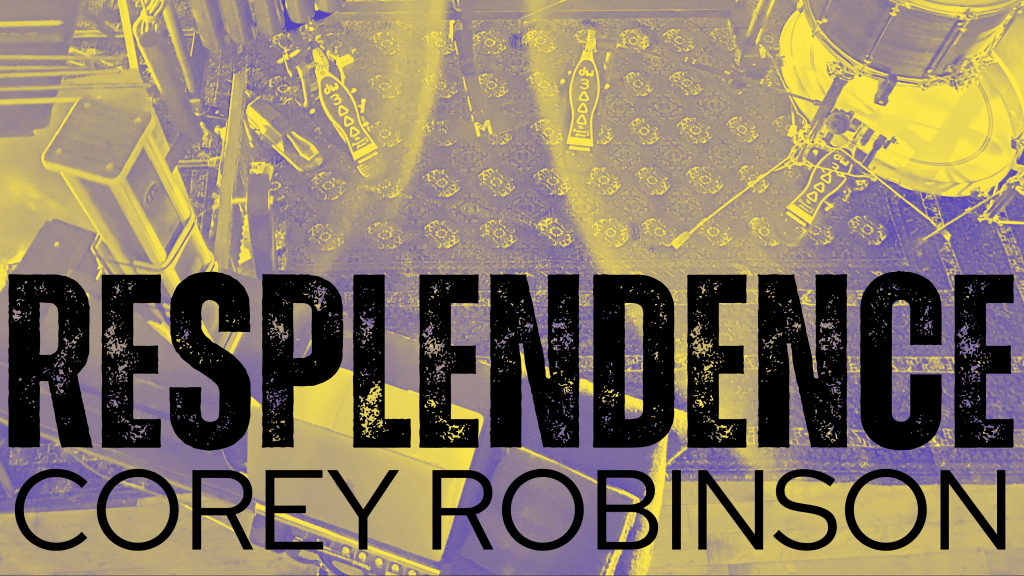
The concept for this album began to take shape in the summer of 2022. I had recently performed We Shall Be Turned by Judd Greenstein for solo multiple percussion. This piece is one in a series of works commissioned by Samuel Solomon of Boston, Massachusetts for a single setup of percussion instruments. The idea of a single percussion setup for an entire concert intrigued me, so I decided to plan a series of pieces I could perform with my own setup.
One feature I wanted to retain was the availability of the vibraphone for performing standard solo vibraphone literature. This pushed some of the instruments to the sides instead of directly in front of the vibraphone. Second, I added the capabilities of a keyboard MIDI controller to open new possibilities for composition. And third, I made sure to keep a concert snare drum available in the setup for the performance of standard concert snare drum literature. When combined, these modifications led to a significantly different setup from Solomon’s, ultimately allowing more flexibility when selecting repertoire. Now, in addition to being able to perform new works written specifically for this setup, works for solo vibraphone as well as solo snare drum could be included.
All of this music was recorded and filmed with the help of drummer Jonathan Mills and recording engineer/YouTube creator, Ron Brenay.
As the setup was solidifying, I asked my good friend and composer, Paul Geraci if he was interested in writing a piece for me. He quickly came back to me with this piece, Snowglobe Dancer.
One challenge with this work was dealing with the rainstick and mark tree. Geraci wrote that I was to perform these instruments throughout the work, while also playing intricate 4-mallet vibraphone parts and glockenspiel melodies. The solution I landed on was to build machines to aid in the performance of these two instruments. The rain stick was mounted on a rotating device so it could be spun and left upright to continue to resonate. I also mounted the mark tree and attached it to a pedal system with an arm to strike the chimes, allowing me control with my foot.
All I Want is the first track on Joni Mitchell’s album Blue, released in 1971. The first time I head this recording, I was taken by juxtaposition of harmonic complexity and rhythmic intensity with the emotional and heartfelt lyrics. The original recording includes Joni Mitchell singing and playing Appalachian dulcimer with James Taylor playing acoustic guitar. Taking these three complex parts and getting them to work with one player on a vibraphone took some careful planning, trial and error, and many edits.
This piece emerged from a treatise written by filmmaker Luis Bunuel in 1922. The unique style of the treatise caught my attention, as Bunuel describes the instruments for what they are (as a noun) rather than what they sound like (as an adjective). Here are some examples:
Violins- Pretentious young ladies of the orchestra, insufferable and pedantic. Jagged mountains of sound.
Violoncello – Murmurs of sea and woods. Serenity. Deep eyes. They have the conviction and the grandeur of Jesus’ sermons in the desert.
Trombones – A slightly German temperament. Prophetic voice. Succentors in an ancient cathedral with ivy and a rusty weather vane.
Xylophone – A child’s game. Water of wood. Princesses knitting in the garden, moonbeams.
Cymbals – Light shattered into fragments.
Timpani – Skins filled with olives.
SnareDrum – Little toy thunder. ‘Somewhat’ menacing.
I felt like the snare drum was boxed into somewhat of a corner here, so I wrote four movements that created four characters of what I think a snare drum can be.
Transfiguration Through Resonance centers around the vibraphone and percussion setup with an electronic MIDI controller playing a large role in the timbre of the piece. All I knew before beginning the writing process was the organization of the setup and that I wanted to perform all the acoustic and electronic instruments live in performance.
The composition of this piece was complicated considerably by the electronics. Not only did I need to come up with what I wanted to write, I also had to figure out how to get the MIDI controller and the computer to execute the sounds I wanted to hear. This would also have to be able to be performed at the same time as the acoustic instruments were being played. There are a few techniques I use to sustain the electronic sounds including reverb, latching, delay effects, a sustain pedal, and altering the envelope of the samples. These techniques allow me time to strike the other instruments before having to go back to the MIDI controller.
Recipe of Life InRecipe of Life for solo vibraphone was inspired by a poem from the sun and her flowers, a collection of poetry from Rupi Kaur.
this is the recipe of life
said my mother
as she held me in her arms as i wept
think of those flowers you plant
in the garden each year
they will teach you
that people too
must wilt
fall
root
rise
in order to bloom
-rupi kaur
Peace Piece is a composition for solo piano by Bill Evans recorded in 1958 as part of his album, Everybody Digs Bill Evans. The work begins with an ostinato outlining a simple chord progression. Evans then spends almost seven minutes masterfully improvising over this ostinato. I decided to utilize a MIDI keyboard to loop the ostinato, allowing me more freedom to improvise.
 Corey Robinson Music